Friday, April 15, 2016

Do-Something-Everyday:


Do-Something-Everyday, April 15, 2016

A plain wood vase transformed into a painted textural piece of art with pyrographic tools. One side is dense with repetitive triangles drawn using hot tips and the colored with Golden fluid acrylics. It has a very nice texture with a 3-d effect. The other side (below) is more traditional with flower patterns. The wood burned flowers are highlighted with surrounding colors.


Thanks for visiting.

Thursday, April 14, 2016

Do-Something-Everyday: Succulent Love and Frida Kahlo

Do-Something-Everyday, April 14, 2016


This is the last of a series of posts called Succulent Love. These are posts showcasing my succulents collection  in interesting planters along with small paintings of succulents that I did. You can find previous posts here, here, and here. The one below is planted in a cigar box with a painting of the plant on the inside lid. 

Cigar boxes are one of my favorite planters for succulents. I use in their natural state which gives a rustic look to the arrangement. I added balled feet to the box so that it would not sit flat on the ground and also be proportionate to the height of the plant. First,  I lined the box with a plastic liner (grocery bag), added two layers of small pebbles. Once the plant was put it into the box, I layered the top soil with spanish moss (that was what I had in hand). To add interest, I drew a painting of the succulent on the inside lid with watercolors. So far, I am liking the arrangement!


To cap the week, I am posting photos from Frida Kahlo: Art, Garden, Life exhibition that New York Botanical Gardens did last fall. It was a multi-disciplinary show designed to highlight the artist's
deep connection with her native land's flora and fauna. The centerpiece of the exhibition was the Enid Hauptman Conservatory reimagined as Casa Azul, Frida's Mexican home and garden that was filled with succulents native to Mexico. As is my wont, I went camera happy and clicked away. Enjoy.


Thanks for visiting.


Wednesday, April 13, 2016

Do-Something-Everyday: Succulent Love, Part C


Do-Something-Everyday, April 13, 2016

This is another cigar box planter with a whole lot of succulents, especially jade plant.  I added balled feet to the box to add a little bit of elevation to the box.


Tuesday, April 12, 2016

Do-Something-Everyday:Succulent Love, Part 2


Do-Something-Everyday, April 12, 2016

I planted this succulent in an old ceramic pot I got  a long time ago from Rag Shop. Rag Shop was a popular regional arts and craft chain store way before Michaels.  Though what it sold was made in the USA, they were very reasonably priced. This planter cost $4. Rag Shop went out of business when the Chinese invasion of cheap goods began via Michaels.


Monday, April 11, 2016

Do-Something-Everyday: Succulent Love, Part 1


Do-Something-Everyday: April 11, 2016

I fell in love with succulents when my daughter gifted us this succulent collection as an anniversary gift. It did not last but since then I have been slowly building my succulent collection. What I  have realized is that I like growing them in interesting containers and that I also liked drawing them. Above is a watercolor sketch of Haworthia,  from the aloe family. The real one is below planted in a recycled wood container upon which I had doodled a zentangled inspired art. I drew a car doodle on the opposite side.


Thanks for visiting. Come again tomorrow for another update on the succulent collection.


Thursday, April 7, 2016

Do-Something-Everyday: Midori Style Felted Cover Journals


Do-Something-Everyday: April 7, 2016

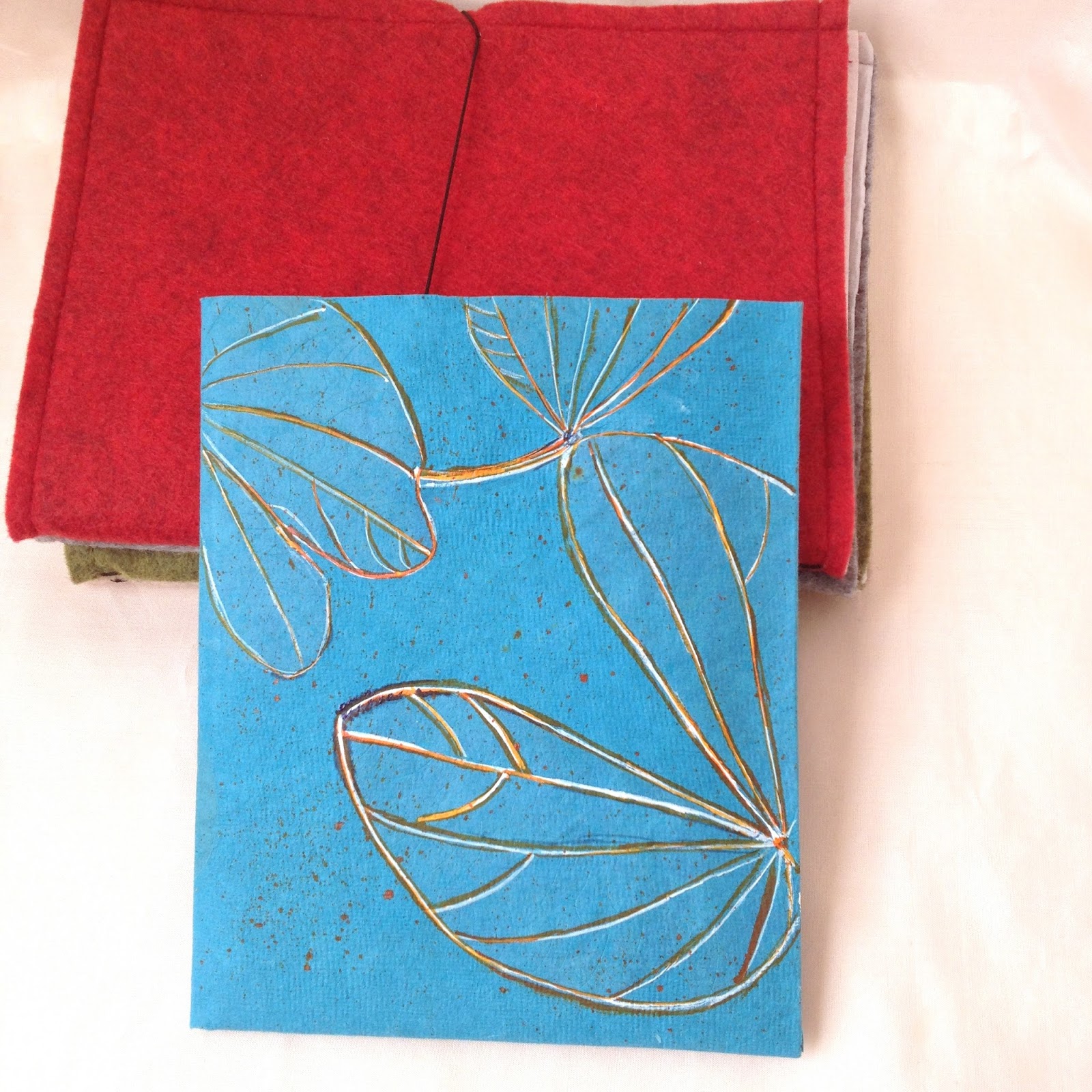
Midori  is a Japanese style journal cover that is entirely removeable.  I made a whole travel journal kit with the removeable as the starting point. There are several combinations of colors and patterns and all of them are available in my Etsy shop

This Midori travel journal kit consists of six items:

1. Midori  style wool felt cover (stabilized with interfacing) with elastic insert and closure, 8"x6" (photo 2). You have a choice of four colors: grey, red, green and beige. Both the larger journal and the folio together fit easily into the cover (Photo 3)

2. Handmade folio/folder to keep all of the items (4-6) below together. The folio is made from 100% handmade paper with lovely leaf impressions. 5.5" by 6.5". (Photos 1 & 3).

3. One 7"x6" hand stitched notebook with 120 pages counting both sides (photo 4). The journal which fits the felt cover is removable. (photo 3)

4. Two hand sewn jotters. 4.5" by 6"; single signature of approx. 40 pages counting both sides; A collection of these journals are in photo 3. The journals will be randomly selected from this collection but I will make them match in color to the folio (Photo 4)

5. Two Post cards: (1) illustrated with David Sibley's backyard birds; (2) Prints from my Indian travels photos. See photo 5. Both cards will be randomly selected from this collection.

6. Matching tiny matchbook, 2.5" by 2"; 20 hand cut and hand assembled pages. Stapled. Kraft envelope lined with a page from old atlas; 5.75" by 4.25"


Thanks for visiting.

Wednesday, April 6, 2016

Do-Something-Everyday: Tales in Foreign Lands


Boule de Suif
 
Do-Something-Everyday, April 6, 2016


In an odd coincidence, the last two weeks I read three novels all set in foreign countries (relative to the U.S.). They also had few other things in common: one is an English translation of stories by a French novelist, another one is about an American translator of Portuguese novels by a Brazilian author and the third one is an English language novel set in a former French colony in the Caribbean. The three books are: The Necklace and Other Stories: Maupassant for Modern Times, translated by Sandra Smith; Ways to Disappear by Idra Novey and, Peacekeeping by Misha Berlinski. The last two are 21st century American novelists while Guy De Maupassant was a late nineteenth century French author. I will be posting a review of each starting with the best first.


I was first introduced to Maupassant via a South Indian movie adaptation of his famous novella Boule de Suif. Later after I had moved to the U.S., I read the English language version of it in a fat volume that included all of his 300+ short stories. That was a while ago. Recent events in Paris and in Western Europe have rekindled my youthful interest in European literature and when I saw the above-mentioned book on the recent arrivals section at my library, I was curious if these stories would hold my interest still. Most did. Even though the stories are set in 19th century France, many of them feel real and true almost 150 years later.

Maupassant’s stories are well known for their surprising plot twists and often leave you wondering “what if”. Take the Necklace (La Parure), for example, which ends with a surprise revelation that the diamond necklace that Madame Forestier loaned to Madame Loisel was really a fake. Now that both women know it was a genuine diamond necklace that Madame Loisel returned to Madame Forestier, would she ask for it back? Would Madame Forestier’s initial honesty extend to giving it back to the rightful owner? I wonder what that conversation would have been like. 

In the Question of Latin (Le Question du Latin), when a former Latin teacher, now a prosperous grocer, exclaims “Oh! Good Lord, Latin, Latin, Latin. A man can’t live on Latin alone!”, could Maupassant have imagined that 150 years later that question would be extended to English literature, Art History, Music, Anthropology and all other disciplines unconnected to commerce? 

Finally, his most famous Boule de Suif (Boule de Suif). It is a good story but surprisingly also a trite one. In making Boule de Suif, a generous, patriotic, sensitive prostitute misused by her hypocritical fellow passengers, the real hero of the story, Maupassant had succumbed to the male fantasy of a hooker with a heart of gold. In the one hundred fifty years since he wrote that story we have seen many versions of that trope (a trope that found its cinematic apotheosis in Julia Roberts’ Pretty Woman). In the post-feminist era, this is one story that does not hold up well.

To sum up. In the skilled translation of Sandra Smith, Maupassant’s stories get a fresh modern update. Give them a try. 

Next week: A review of Ways to Disappear by Idra Novey.

I have posted several photos of Santa Fe Folk Art Museum on this blog post. Click here to view them.

Thanks for visiting.