Sunday, October 16, 2011

Number 10 in the Series: Yoga Art


Yesterday, I completed the tenth and the eleventh painting in my elephant yoga art series, which felt like a bit of a milestone. Two years ago, when I did my first piece (below) I did not think I had the imagination to continue with it for this long. In the overall scheme of things, ten is  not a huge number especially given that Patanjali's yoga sutras have hundreds of yoga postures of which at least fifty are currently practiced and, I should have been able to churn out one art piece every week. It was slow going for me mainly because I wanted to depict the poses as accurately as possible while finding a proper way to align the trunk (!), simultaneously maintaining the beauty and the dignity of the character (elephant) doing the poses. Then there was always the question of how to make the baby elephant part of the story. The idea for the asana usually tends to come after the daily yoga practice and I will it work in my head during my long daily commute and then start sketching it on paper.  I am not a a quick draw artist. So, at this stage, eraser becomes absolutely indispensable as you can see below.


Over the course of two years,  the  paintings  evolved organically and began to find its audience. Because I had decided that I would not sell copies, each and every buyer gets an original painting done fresh and new for her. Yes, my buyers are usually women and many of them are from the West Coast.

You can read more about the evolution of my yoga art here. Below are images from my complete yoga series and, you will find them all in my Etsy shop.


Most Popular!


First and Favorite!


Young Mothers' Favorite


Another Young Moms' Favorite


My Sister's Favorite


Monday, October 10, 2011

How Do You Say Soap in French?


As you know, I like decorating boxes. Inspiration to decorate the box with french soap labels when I happened upon several of them at the Graphics Fairy site under the French category. To keep it cohesive, I decided to use several of the lovely soap labels (or savon as they are called in French). To start with, I decoupaged a background layer of sheet music and then adhered the labels on top. I stained the sides and stamped on the top, added a bit of glitter glue and it was done.

Thanks for visiting.

Sunday, October 2, 2011

Something Old, Something New, Something Borrowed....


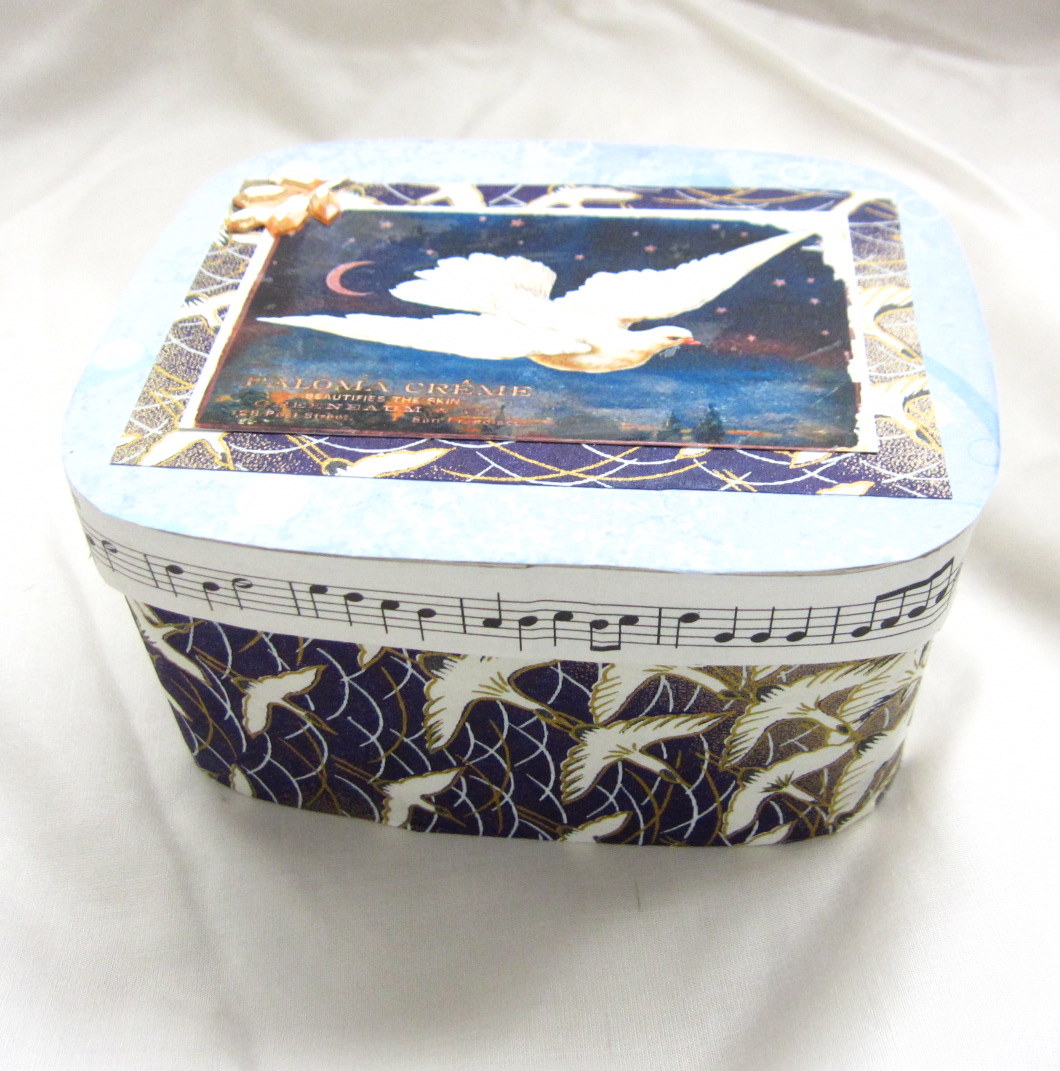
This weekend I worked on decorating a whole set of wood boxes with bird theme. For bird images, I went to the popular and ever generous free graphics site The Graphics Fairy. In addition to the vintage bird images, I also threw several other types of paper such as chiyogami, music sheet and regular scrap paper into the mix. Hence the title above. This mix n' match makes these boxes visually more interesting, I think. Take a look.


Thanks for visiting.

Sunday, September 25, 2011

Chalkboard Cloth Halloween Tags


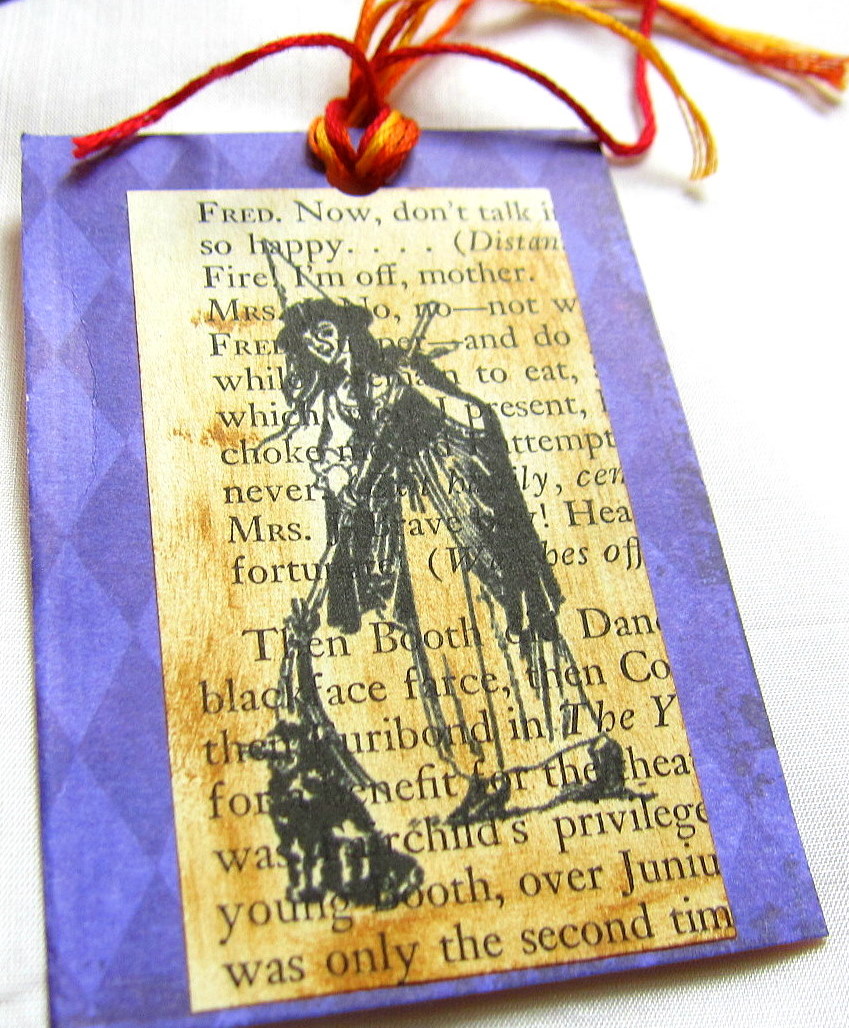
I was inspired to create these tags when I saw this fabulous clip art from the Graphics Fairy. I found so many more that I just had to make some art with them.

To make these tags, I first printed these images on pages torn from a 1950 biography of an actor. With cropping and careful placement I could print about three to four images on a single page. I deepened the vintage look by inking the edges with distress ink. I adhered the image on to one side of a halloween themed scrap paper. On the other side, I adhered a cured piece of chalk cloth (not chalk paint). The two photos above show the front and the back. The pictures below show the individual tags. A nice warming project for a gray rainy Saturday morning.

* You can get the chalkboard cloth from this online store.


Thanks for visiting.

Wednesday, September 21, 2011

Impermanence


The Paper Stacks, an online collaboration hosted by Seth Apter of Altered Page, starts tomorrow. Although it is called Paper Stacks, Seth defines it broadly to include "papers, books, journals or anything else of your liking". So, I decided to make a stack of my fabric stash. It was quite tricky because georgettes and the chiffons are slippery materials and I wanted to create the same dimensional look that a stack of books would give. As I piled one on top of the other I did ever so gently holding my breath which I did not let go till I took the photo above. Then came dissolution.  papers, books, journals, or anything else of your liking

Monday, September 12, 2011

The Big Temple, Tanjore, India


Ornamented Exterior, Big Temple


Main Entrance, Big Temple


The Hindu temple is a condensed image of the cosmos constructed as a mandala  known as the vastu purusa mandala. The Purusa refers to the Universal essence which is without form or substance; Vastu refers to the site or the bodily existence or substance of Purusa. At the center of the mandala is the sanctum where the divine image is placed; this divine image, made in stone or wood or brick is the material consecrated representation of the Universal essence.

The building of the Hindu temple is not left to the imagination or the creativity of the shilpi (architect) or the artisans; it is strictly guided by the sacred texts called the shilpa shastras. The construction of a temple, from start to finish, is considered a ritual activity. Architecturally, the Hindu temple resembles a mountain and represents the link between heaven and earth. The triangular tower like structure is called  the shikara or gopuram and is located directly over the inner sanctumLike a mountain, the exterior of the temple is lush with intricate carved representation of various plant, animal, human and divine forms, while the inner sanctum, where the main deity is placed, with enclosed walls is dark. The interior of the temple directs our attention to the center, the garbha or the womb, that which is the source of the Universe. The inner sanctum is called the garbagraha or the womb chamber.

The journey of the worshipper to the temple is considered a pilgrimage in itself. The pilgrim starts the journey by circumambulating the temple first, the exterior form of the Universe, then walks to the interior sanctum, the center of the Universe. Approaching the sanctum, the worshipper performs another circumambulatory passage around the sanctum before "seeing" the deity at the center. The deity in the inner sanctum is the primary consecrated image of the temple, though a temple may have several secondary gods housed in various shrines placed in appropriate quadrants of the mandala.

A Hindu goes to the temple to receive 'darshana', a Sanskrit word meaning "seeing". It is a dialectical act, seeing the divine and being seen by the divine. According to Hindu theology, God is present in the image and is real.  By standing in front of the image and looking into its eyes, the worshipper seeks the divine blessings.

The images shown here are of the Brihadeeshwara Temple, a designated UNESCO World Heritage site that turned 1000 years old last year. It is located on the banks of river Cauvery in the town of Tanjore, Tamilnadu, India. It was built by one of the emperors of the Chola dynasty, Rajaraja Chola. As befitting the richest empire of its time, it was built on a large scale and came to be called the Big Temple. Dedicated to  Hindu god Shiva, its most striking features are the 200 ft tall tower (gopuram) that rises from the base sanctum, the massive granite cupola (vimana) at the top of the tower and majestic stone image of Nandi, the sacred bull.  It is one of the best examples of the south Indian style temple architecture.

I have not been the temple myself but my husband got the chance to see it just as it was being renovated. I think these photos have captured its majesty and magnificence.


Nandi, the sacred bull


Thanks for visiting.

(Photos courtesy: S.V. Govindan)

Saturday, September 10, 2011

A Rainbow of Colors!


For my birthday this year, my dear daughter gave me something that absolutely warmed the cockles of my heart---tons of handmade papers of every possible hue, and woodblock stamps.


Just looking at the colors and smelling the papers made me heady. I wanted to use every one of them immediately in something. So what did I do? Made a journal, of course. As you can see from the photo above, it is a veritable rainbow of colors. (As I was leafing through the pages of the journal, I could not but notice that it had all of Pantones' Fall 2011 colors!) The papers are naturally made, they still have the  faint fragrance of the material and each paper has many leaf imprints. To give the papers a rustic look, I tore the papers by hand.

As I was putting the journal together, I thought that the cover page needed something extra to make it stand apart from the rest of the journal. So, I hand embroidered along the edges of the leaf imprints which created a bas-relief look and made the cover pop.  I finished the journal with a wrap round cotton cord with wooden bead ends closure.

Available for purchase in my  Etsy shop.


Sales from this and every item in this ship go to support handicapped Indian children at Sukriti Social Foundation. 

Thanks for visiting.