Sunday, September 25, 2011

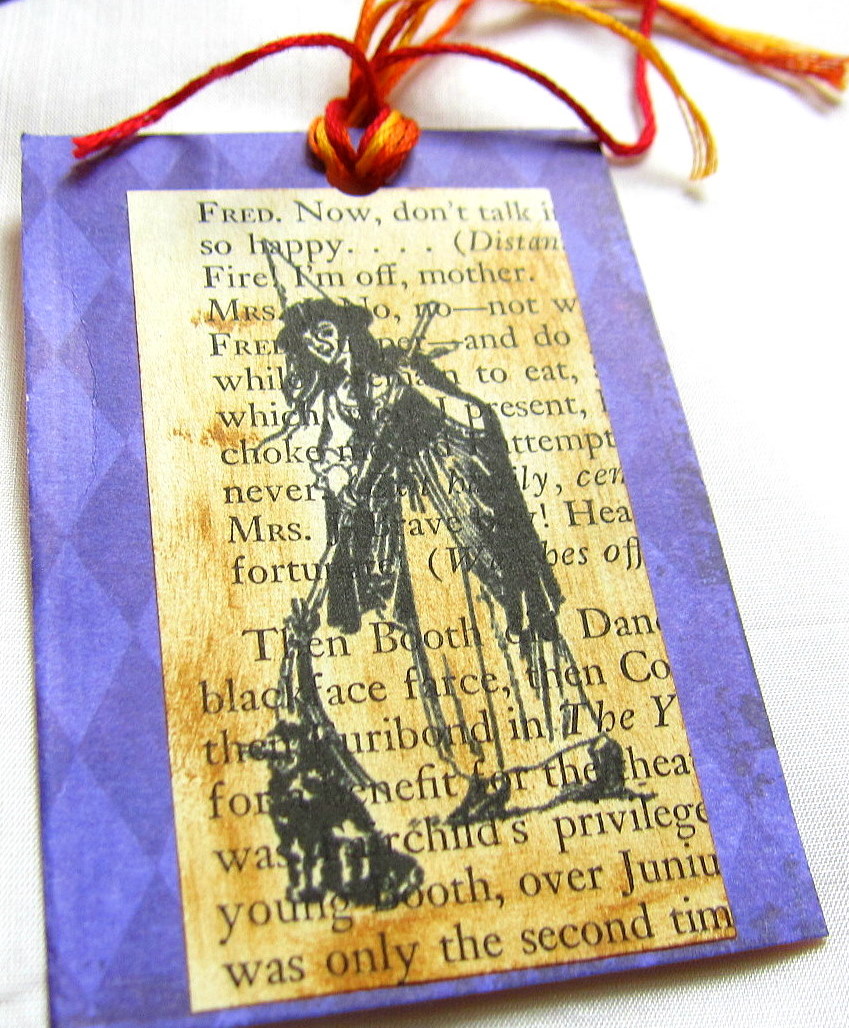
Chalkboard Cloth Halloween Tags


I was inspired to create these tags when I saw this fabulous clip art from the Graphics Fairy. I found so many more that I just had to make some art with them.

To make these tags, I first printed these images on pages torn from a 1950 biography of an actor. With cropping and careful placement I could print about three to four images on a single page. I deepened the vintage look by inking the edges with distress ink. I adhered the image on to one side of a halloween themed scrap paper. On the other side, I adhered a cured piece of chalk cloth (not chalk paint). The two photos above show the front and the back. The pictures below show the individual tags. A nice warming project for a gray rainy Saturday morning.

* You can get the chalkboard cloth from this online store.


Thanks for visiting.

Wednesday, September 21, 2011

Impermanence


The Paper Stacks, an online collaboration hosted by Seth Apter of Altered Page, starts tomorrow. Although it is called Paper Stacks, Seth defines it broadly to include "papers, books, journals or anything else of your liking". So, I decided to make a stack of my fabric stash. It was quite tricky because georgettes and the chiffons are slippery materials and I wanted to create the same dimensional look that a stack of books would give. As I piled one on top of the other I did ever so gently holding my breath which I did not let go till I took the photo above. Then came dissolution.  papers, books, journals, or anything else of your liking

Monday, September 12, 2011

The Big Temple, Tanjore, India


Ornamented Exterior, Big Temple


Main Entrance, Big Temple


The Hindu temple is a condensed image of the cosmos constructed as a mandala  known as the vastu purusa mandala. The Purusa refers to the Universal essence which is without form or substance; Vastu refers to the site or the bodily existence or substance of Purusa. At the center of the mandala is the sanctum where the divine image is placed; this divine image, made in stone or wood or brick is the material consecrated representation of the Universal essence.

The building of the Hindu temple is not left to the imagination or the creativity of the shilpi (architect) or the artisans; it is strictly guided by the sacred texts called the shilpa shastras. The construction of a temple, from start to finish, is considered a ritual activity. Architecturally, the Hindu temple resembles a mountain and represents the link between heaven and earth. The triangular tower like structure is called  the shikara or gopuram and is located directly over the inner sanctumLike a mountain, the exterior of the temple is lush with intricate carved representation of various plant, animal, human and divine forms, while the inner sanctum, where the main deity is placed, with enclosed walls is dark. The interior of the temple directs our attention to the center, the garbha or the womb, that which is the source of the Universe. The inner sanctum is called the garbagraha or the womb chamber.

The journey of the worshipper to the temple is considered a pilgrimage in itself. The pilgrim starts the journey by circumambulating the temple first, the exterior form of the Universe, then walks to the interior sanctum, the center of the Universe. Approaching the sanctum, the worshipper performs another circumambulatory passage around the sanctum before "seeing" the deity at the center. The deity in the inner sanctum is the primary consecrated image of the temple, though a temple may have several secondary gods housed in various shrines placed in appropriate quadrants of the mandala.

A Hindu goes to the temple to receive 'darshana', a Sanskrit word meaning "seeing". It is a dialectical act, seeing the divine and being seen by the divine. According to Hindu theology, God is present in the image and is real.  By standing in front of the image and looking into its eyes, the worshipper seeks the divine blessings.

The images shown here are of the Brihadeeshwara Temple, a designated UNESCO World Heritage site that turned 1000 years old last year. It is located on the banks of river Cauvery in the town of Tanjore, Tamilnadu, India. It was built by one of the emperors of the Chola dynasty, Rajaraja Chola. As befitting the richest empire of its time, it was built on a large scale and came to be called the Big Temple. Dedicated to  Hindu god Shiva, its most striking features are the 200 ft tall tower (gopuram) that rises from the base sanctum, the massive granite cupola (vimana) at the top of the tower and majestic stone image of Nandi, the sacred bull.  It is one of the best examples of the south Indian style temple architecture.

I have not been the temple myself but my husband got the chance to see it just as it was being renovated. I think these photos have captured its majesty and magnificence.


Nandi, the sacred bull


Thanks for visiting.

(Photos courtesy: S.V. Govindan)

Saturday, September 10, 2011

A Rainbow of Colors!


For my birthday this year, my dear daughter gave me something that absolutely warmed the cockles of my heart---tons of handmade papers of every possible hue, and woodblock stamps.


Just looking at the colors and smelling the papers made me heady. I wanted to use every one of them immediately in something. So what did I do? Made a journal, of course. As you can see from the photo above, it is a veritable rainbow of colors. (As I was leafing through the pages of the journal, I could not but notice that it had all of Pantones' Fall 2011 colors!) The papers are naturally made, they still have the  faint fragrance of the material and each paper has many leaf imprints. To give the papers a rustic look, I tore the papers by hand.

As I was putting the journal together, I thought that the cover page needed something extra to make it stand apart from the rest of the journal. So, I hand embroidered along the edges of the leaf imprints which created a bas-relief look and made the cover pop.  I finished the journal with a wrap round cotton cord with wooden bead ends closure.

Available for purchase in my  Etsy shop.


Sales from this and every item in this ship go to support handicapped Indian children at Sukriti Social Foundation. 

Thanks for visiting.

Saturday, September 3, 2011

Old Town, Key West


On my first trip to Key West this summer I, like every other tourist, took one of those guided tour on the trolley that took us around the original Key West neighborhood called "Old Town" that included Mallory Square, Duval Street, the Truman Annex and Fort Zachary Taylor. In addition to the well known landmarks like the La Concha Hotel (legend has that playwright Tennessee Williams completed his famous play "Streetcar Name Desire" while staying at the hotel), Truman White House, Duval Street, we got to see many many classic bungalows and guest mansions representing the local architecture. Some of its distinctive features are the peaked metal roofs, pastel colors, gingerbread trim, covered verandas or balconies, louvered shutters, and last but not the least, lush tropical vegetation. Almost all of them were also impeccably maintained. I managed to capture a few on the camera below. Enjoy!


Its rundown condition made it stand out
A rare bright hued house


Historic movie theater now home to Walgreens

A local  among the tourists!


Thanks for visiting.


Monday, August 29, 2011

Yoga Art Anantasana Reclining Posture


The word "ananta" in Sanskrit means Eternal. It also refers to the serpent bed of Vishnu, the Hindu god, lying on the ocean of eternity. In yoga, it is an asana for improving the mobility of the spine and hips and opening the groin. In this asana, the body reclines on the side, one leg extending up toward infinity. It is a relaxing pose but intense too. While the head is resting comfortably in the palm of the hand, the challenge is in stretching the other leg straight updwards while keeping the body in alignment.

I think, Lochanadevi is well-versed in doing this pose although, being an elephant she does need the help of a flower belt to keep her leg upright. Even in this pose, she looks like an Indian Queen, all bedecked in colorful jewelry!. This pose also is inviting to the Baby to curl up snugly against Mom. What do you think she is doing with the flower cord around her trunk--being mischievous or helping her mama?

The inspirations for my yoga art come from my long practice of yoga and, from raising a family with all the ups and downs that go with it. We know as parents, the joy of when our children want to be exactly like us, the puzzlement of when they absolutely do not want to be like us and the satisfaction of when they learn to find a balance.

I depict mother elephant and her calf instead of humans in my yoga art humans because elephants are matriarchal and very family oriented animals. Elephants are also the most beloved of Indian animals and they are also very agile and flexible and it was entirely possible to imagine the mother elephant doing all those yoga poses while the little one watched. Hathi means elephant in Hindi and hence the play on Hatha yoga as hatha (i) yoga.

The painting is done in Indian folk art style--the images are unidimensional but have great details. In the typical folk art style, the watercolor paper was first dyed into variegated brown shades using several natural dyes. The painting itself is done mostly with primary colors. There is also a border around the central image, also typical of this style of painting. I call the mother elephant Lochana because she has such big beautiful eyes.

The elephants are heavily decorated which is a commonly found in Indian paintings and in real life also.

Available in my Etsy shop and for more work on my yoga art series please visit my shop http://www.etsy.com/shop/DharmaKarmaArts?section_id=6511983


**Proceeds from the sale are donated to support physically handicapped children and adults. For more information, go to www.sukriti.org

Thursday, August 18, 2011

Yoga Art: Warrior III


The inspirations for my yoga art come from my long practice of yoga and, from raising a family with all the ups and downs that go with it.


I named the mother elephant Lochanadevi because she has such beautiful eyes. Lochanadevi, like all modern mothers, is super busy juggling multiple roles on a daily basis. And, setting aside some personal time for yoga and meditation practice is a big challenge. Luckily for her, her young ones like to hang out with her.  The Warrior pose III or Veerabhdrasana gives both strength and balance that the mother elephant is metaphorically striving for.

I depict mother elephant and her calf instead of humans in my yoga art because elephants are matriarchal family oriented animals and, are also the most beloved of Indian animals. They are very agile and flexible. It is easy to imagine the mother elephant doing all those yoga poses while the little ones watched. I also call this yoga art Hatha(i) art. Hathi means elephant in Hindi and hence the play on Hatha yoga as Hatha(i) yoga.

The painting is done in Indian folk art style--the images are unidimensional but have great details. In the typical folk art style, the watercolor paper is first dyed using tea and coffee. The painting itself is done mostly in primary colors. In India, elephants in real life are decorated with silk, gold and silver ornaments during religious festivals, and in art too they are so depicted.

I prefer to do it this way because yoga inspires my art and my art is a source of vitality and 

All my yoga paintings are original, drawn and painted one at a time for the collector. 

energy for my yoga practice.