Friday, October 1, 2010
Three of a Kind!
As artists we are supposed to love every one of our creations, but , often , we love some more than the others. We tend to have preferences for certain colors, materials, textures and forms that we repeat over and over again. In my own work, I am inclined to use a lot of magenta, blues, oranges and other earthy colors. This box below is a perfect example of what I mean. I have done three variations of the same color and materials but each one subtly different from the other. They also sell well at the craft shows, so I keep making more of them. I think there are more of these in my future :). You will find these in my Etsy shop and for other decorative boxes click here
Saturday, September 25, 2010
Illustration Friday: Old-fashioned
This is my submission for Illustration Friday Challenge "Old-Fashioned". Writing in cursive using a fountain pen? Now, that's truly old-fashioned!
Monday, September 20, 2010
Diary 2011 Project
![]() |
| My Artwork for Diary 2011 |
Friday, September 10, 2010
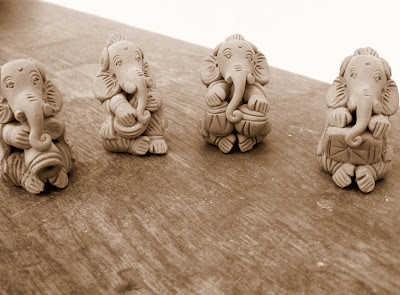
Ganesha Reimagined
![]() |
| Ganesha Reimagined |
I took these pictures many months ago and even though I had been thinking of writing about them for a while now, I felt uninspired. A week ago, when my friend Diane Fergurson asked me if I would write an article for the Mind, Body and Spirit blog, suddenly it clicked. May be because tomorrow is Ganesh Chaturthi, the festival of Ganesha's birthday. Ganesha is one of the most adored in the Hindu pantheon of gods and Ganesh chaturthi is grandly celebrated by the natives of Indian states of Maharashtra, Tamilnadu, Karnataka and Andhra Pradesh. In the US, Ganesha is a familiar figure to those who practice yoga.
Ganesha is also called Vigneshwara, "remover of obstacles". At the start of any auspicious occasion, the blessing of Ganesha is sought with the recitation of the verse:
Om shuklambaradharam vishnum sasivarnam chaturbhujam
prasannavadanam dhyayet sarvavignopashantaye
(I meditate upon the all pervading Ganesha, the one with four arms and moon like bright complexion,
clad in white, ever smiling, to remove any obstacles in my endeavor)
Yet the image of Ganesha with his elephant head and a potbellied human body has fired up the imagination of Hindu artists and has become anything and everything they want him to be. In their hands he could be a busy businessman cooking up deals on the phone or an elderly gentleman taking an afternoon nap or a percussionist in a band or a a stylish beau out on stroll swirling his walking stick or a yoda-like figure or a joyous dancer. This trend started about twenty years ago when it became a hobby for many to collect these cute and charming images of Ganesha. These images are usually made in clay but sometimes they are also made in precious gemstones for the rich collectors. My sister is a collector too and the collage above shows a few a from her collection. It is always fun to stand in front of the curio cabinet and look at her collection of ganeshas because they bring a smile to your face and joy to your heart.
| Whereto? |
| Music anyone? |
| Vishnu Ganesha |
![]() |
| Iconic OM (photo courtesy: Creative Commons) |
Sunday, August 29, 2010
Papers, Notebooks and Memories
Back when I was a school girl, summer vacations began and ended with bookbinding. At the beginning of summer, my father would handsew tons of pamphlet journals for us to practice our handwriting and write "dictionary meaning" (which was looking up meaning for words in Tamil-to- English and English-to-Tamil dictionaries). We spent the last week of summer, before school opened, covering our brand new textbooks and notebooks with crisp brown kraft paper. We would cut the paper using an old razor blade (neither my father nor my mother would part with their scissors) and glue the covers with homemade rice starch. And then, we would carefully write our name,-- in cursive of course, that was whole point of practicing handwriting--class and the room number. Oh, what fun it was! More fun than the school itself. Interestingly, we were never allowed to decorate the covers which was seen as frivolous and would garner a good scolding not only from the parents but also from the teachers.
My father passed away eleven years ago and my mother just recently. And, I find myself cutting, pasting, sewing and binding notebooks and journals once again. I have also resumed my teaching. There is something deeply meditative about bookmaking--as one immerses oneself in carefully measuring, aligning, punching, cutting, sewing and gluing, one enters into a zone of deep silence, just the hands and the papers moving together in quiet harmony. During these moments, I find myself doing a lot of thinking not just about my parents, but also about the course materials, the syllabus and the students.
With the amount of junkmail that I get at home and at work, there is never any shortage of materials for making journals and notebooks. The one above and below are some of the mini journals I made using junk mail, brown paper bags, unused papers, notepads etc.
This one below is more than six years old. My daughter bought it in Rajastan, India way back in 2004. The cover is made of camel leather and embossed appropriately with an image of a camel. It is handsewn and has held up quite well even after so many years.
Below is a stash of repurposed notepads as bookboards, handsewn signature--all ready to be transformed into a notebook or a journal.
`
Friday, August 20, 2010
The Age of Copper
| Copper, Green Opals and Turquoise Perfect Together! |
The skyrocketing price of gold and silver has made copper an alluring and affordable choice in jewelry designs in recent times. Besides, in this era of increased yearning to be one with nature, the color of copper instinctively evokes the warmth of the sun, the rustle of the autumn leaves and the swirling of the desert sands making it suitable for many types of artwork.
Copper is a naturally occurring mineral and copper was known to some of the oldest human civilizations including the Mesopotamian and the Indus Valley civilizations. The Copper Age lasted from 10000 B.C. to 3500 B.C when it was succeeded by Bronze (which is an alloy of Copper) Age. The use of copper in agricultural tools, utensils, building materials, jewelry and later on in plumbing and electrical fixtures continued well into the modern age.
![]() | ||
| Patinated Copper Roof on the Minneapolis CIty Hall (Photo: Creative Commons) |
![]() |
| The Statue of Liberty has 179,220 pounds of copper (Photo: Creative Commons) |
In India where I spent my the first two decades of my life, copper utensils were very much part of our life. I vividly remember the big coal burning copper boiler that we used in winter months for heating water. It was a glorious piece capable of heating about 50 gallons of water and my mother always kept it polished to its full coppery sheen with salt and tamarind paste. But, copper was burdensome to maintain for the already overworked housewives and the advent of stainless steel supplanted its use in the kitchen. Which is a pity because copper is antibacterial with the ability to kill several potentially harmful pathogens. It is also an essential nutrient for human health. Copper rich food are oysters, lobsters, brazil nuts, black pepper, sunflower seeds, avacodo and green olives.
Copper is a very malleable metal and an excellent conductor of heat and electricity. It is associated with the planet Venus and is considered beneficial for promoting love, positive relationships and peace. Copper yantras (tantric designs engraved on thin copper plates) are particularly favored by the Hindus.
In jewelry designs, copper combines fabulously with dark, rough, semi-precious stones like turquoise, green opal or lapiz lazuli. With fall around the corner, this may be the best time to incorporate copper in your art.
Saturday, August 7, 2010
Sari Art Mixed Media Yin and Yang in Autumn
This sari art is my interpretation of the Daoist concept of Yin Yang-- dark-light, strong images-soft lines, text-symbols are brought together to create a unified whole. Select wisdom sayings from Dao De Jing are printed in soft colors on the background along with the Chinese symbol of harmony and peace. The fusion of Indian materials and colors with Chinese text and symbol is also very yinyang.
You can find more about this artwork here : yin and yang
Subscribe to:
Posts (Atom)